
Almost every week someone writes to me asking for "just a logo". Sometimes that really is all they need. More often, what they're describing — "I want the shop sign, the Instagram page and the new website to finally look like the same business" — is not a logo at all. It's a brand identity. The difference decides how much you spend, how long it takes and whether you'll be paying someone to fix it again in two years. Here's how I explain it to clients before they buy anything.
A logo is a mark. A brand identity is the system around it
A logo is one graphic: a symbol, a wordmark or both. It helps people recognise you. That's its whole job.
A brand identity is the set of rules that makes everything you publish look like it came from the same place: the logo and its variations, a colour palette with exact values, typefaces and how to use them, and a short guide that tells a printer, a sign maker or your nephew who "does social media" what's allowed. Some studios also include strategy and messaging — your positioning, tone of voice, tagline — which is where the bigger agency budgets come from.
Put simply: a logo answers "what do we look like on the door?" A brand identity answers "what do we look like everywhere, without calling the designer every time?"
A logo gets you recognised. A brand identity gets you recognised the same way on every screen, sign and receipt.— the short version I give clients
What a small business identity actually includes
You don't need a 60-page brand book to run a bakery, a dental practice or a car repair shop. You need a small set of assets that cover the places customers actually see you. For a typical small business, that means:
Logo + variations
Main version, a compact or stacked version, an icon for favicons and profile pictures, and one-colour versions for stamps, embroidery and engraving.
Colour palette
Two to five colours with exact codes for screen (HEX/RGB) and print (CMYK), plus which ones are safe for text so your site stays readable.
Typography
One or two typefaces, with rules for headings and body text — and web-safe choices so your website matches your print.
Everyday applications
Business card, shop sign, social media templates, email signature — the things you'll use in the first month.
A one-page guide
Clear space, minimum size, do's and don'ts. Short enough that people actually read it.
Source files you own
Vector files (AI, SVG, PDF) plus exports in every size, handed over with no licence to renew.
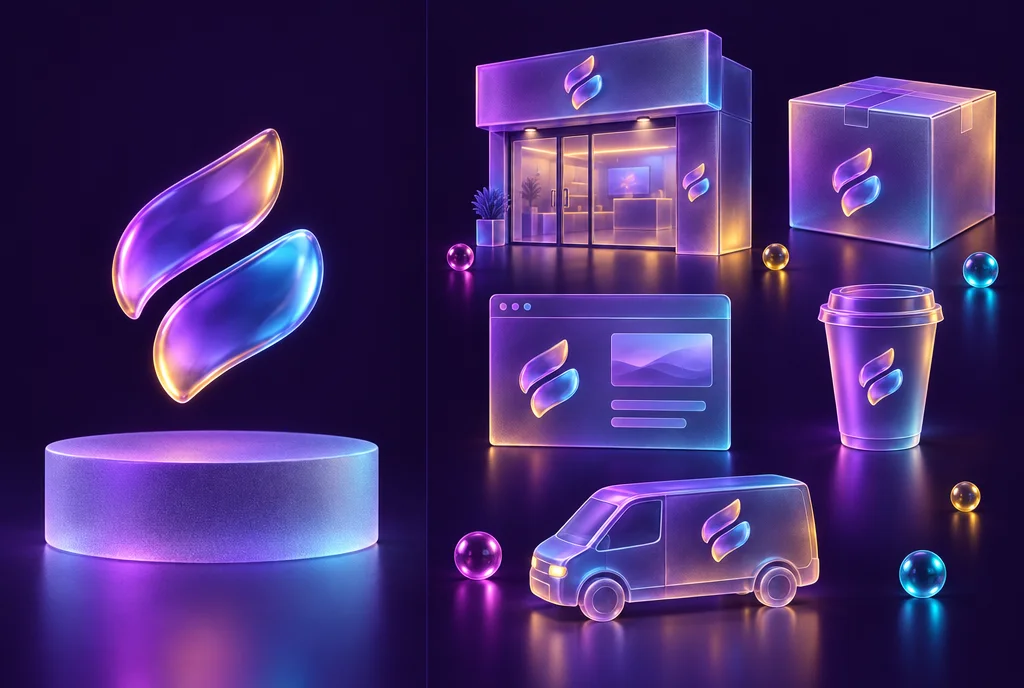
When "just a logo" really is enough
I'm not going to pretend everyone needs the full package. A logo on its own is a reasonable choice when:
- you're testing an idea — a pop-up, a side project, a first season at the market;
- you have very few touchpoints — say, an invoice template and a Facebook page;
- you already have established colours and fonts you're happy with and only the mark itself is weak.
In those cases, spend less, launch, and come back to the system once the business proves itself. Just make sure you still get vector files and a one-colour version — those are the two things people most often have to pay for twice.
When you need the full identity
You need more than a logo the moment several people or suppliers produce things in your name. A few typical triggers I see:
- You're about to order signage, vehicle graphics or packaging — expensive to reprint if the colours are wrong.
- You're launching or redesigning a website and want it to match your shop, not fight it.
- Different people post on your social media and it looks like three different companies.
- You're opening a second location, franchising, or pitching to bigger clients.
- Your printer keeps asking "which purple?" and nobody knows.
A PNG from 2019, three "almost the same" greens, a different font on the menu, the sign and the website. Every new flyer starts with a guess.
One folder: logo versions, exact colour codes, two fonts, templates. Anyone who makes something for you gets it right the first time.
What it costs in 2026 — and what drives the price
Market prices vary enormously, so treat the following as indicative only. Shopify's 2026 guide to branding packages puts basic packages (logo, palette, simple guidelines) at roughly $1,000–$5,000, with strategy-led packages from $5,000 up. A UK studio's 2026 guide quotes around £800–£5,000 for professional logo-only work and £3,000–£15,000+ for a strategic brand identity. Prices in Bulgaria are usually lower, but the same logic applies: you pay for research depth, the number of concepts, the number of applications and how many revision rounds are included.
For comparison, my own brand identity package is €690 and takes 2–3 weeks: three distinct logo directions, two revision rounds on the one you choose, palette and typefaces with clear rules, business card, sign and social media kit designs, and all source files. Smaller jobs — refreshing an existing logo file, a single social template — start from €90, and custom illustration from €190.
Whoever you hire, ask for a written scope that lists exactly which files and applications you'll receive. "Logo design" on an invoice can mean anything from one JPG to a complete system.
Don't forget the trade mark
A new name and logo are worth protecting before you print 5,000 bags. Two things worth knowing as of today:
The EU Intellectual Property Office's SME Fund normally refunds a large share of trade mark fees for small businesses, but for 2026 the trade mark and design voucher has closed early because demand used up the money. If you plan to register in 2027, keep an eye on the next round. A national registration with the Bulgarian Patent Office is the cheaper route if you only sell in Bulgaria — and either way, run a quick search of existing marks before you fall in love with a name. I'm not a lawyer, so for anything beyond a first check, talk to an IP attorney.
A checklist you can do today
Before you contact any designer, spend twenty minutes on this. It will make every quote you receive easier to compare:
- Collect every place your brand appears: sign, website, social profiles, Google Business Profile, invoices, packaging, uniforms, vehicle.
- Photograph or screenshot each one and put them side by side. Are the colours, fonts and logo versions consistent?
- Check what files you actually have. Do you own a vector version (SVG, AI, EPS or PDF)? If you only have a JPG, that's your first problem.
- List what you'll need in the next 12 months: new sign? New website? Packaging? That list defines the scope.
- Write one sentence about who your customers are and how you want them to feel. A good designer will ask you anyway.
- Search the name in the EU and national trade mark databases before any design work starts.
Where your website fits in
For most small businesses the website is the place where an inconsistent brand shows first: a logo stretched in the header, a colour that almost matches the sign, a font chosen because it was the theme's default. If you're planning a new site, it's worth doing the identity first, or at least at the same time — the site then gets built on real colours and type instead of guesses.
Not sure how your current site holds up? Run the free website check — it takes a minute and shows you what to fix first. If the brand needs work, have a look at what's included in my brand identity service; if it's the site, the web design page explains how I build them, from €890 and live in 2–5 weeks. Either way, you'll know whether you need a logo, a system or both before you spend a cent.